


Introduction to Cobra Pose Bhujangasana
Bhujangasana is one of the most essential prone backbends in classical Hatha and Vinyasa Yoga and is more commonly known in Western yoga traditions as the Cobra Pose or Snake Pose. Cobra Pose is a major movement in traditional sequences like Surya Namaskar (Sun Salutations) and a fundamental pose for opening the heart, increasing spinal mobility and restoring posture.
The pose resembles that of a hooded cobra raising its head and upper torso off the ground. The True Cobra Pose may appear simple at first glance, but it requires a nuanced integration of muscular engagement throughout the posterior chain, mindful grounding thru the lower body, and spatial awareness to avoid over-compression of the lumbar spine.
Whether in the gentle warming posture of Baby Cobra or a deep extension, Bhujangasana is an antidote to modern sedentary habits—the forward head posture, rounded shoulders, and collapsed chest that result from long hours at a desk.
Cobra Pose Etymology and Spiritual Significance
The Sanskrit Roots
The term Bhujangasana is derived from two Classical Sanskrit roots:
- Bhujanga (भुजङ्ग): Meaning “serpent” or “cobra.” The word itself combines bhuja (bend or arm) and ga (to go), describing the sinuous, curving movement of a snake.
- Asana (आसन): “seat”, “posture”, “steady pose”.
Esoteric and Symbolical Meaning In the symbolism of Kundalini and yogic philosophy the snake is the symbol of potent latent energy (Kundalini Shakti) which is at rest in the base of the spine (Muladhara Chakra). The raising of the chest of the cobra is symbolic of the uncoiling and upward movement of the evolutionary spiritual force thru the central channel (Sushumna Nadi).
Bhujangasana is a key posture for reawakening internal body heat (Agni), dispelling disease and strengthening vital force (Prana), according to classical texts such as the Gheranda Samhita.
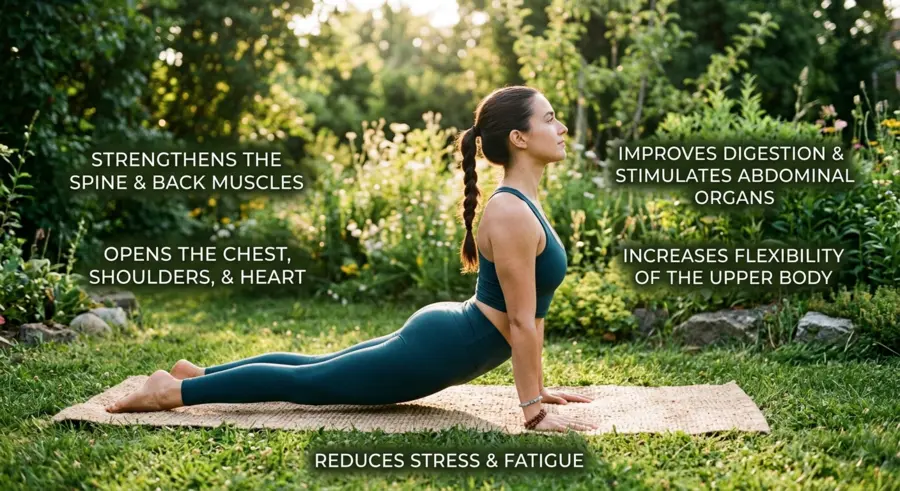
Cobra Pose – Bhujangasana Benefits
1 – Reduces abdominal fat:
Beauty lovers also enjoy the benefits that yoga brings. Many people see the snake pose, or Bhujangasana, as one of the best poses for a toned stomach. Bhujangasana can improve your beauty by stretching your abdominal muscles.
2 – Enhances circulation:
A healthy blood circulation is vital to keep you active and energetic levels. One of the major benefits that comes from Bhujangasana lies in the ability it has to boost blood circulation. Improved circulation supplies your body’s cells with oxygen and nutrients. In addition, a better flow of blood helps to maintain hormonal balance.
3 – Cobra Pose for Stress Management:
If you’re struggling with problems with depression or anxiety It’s not a bad thing! The practice of yoga bhujangasana can lessen the symptoms of stress.
The symptoms are headaches, fatigue and a lack of strength. In addition, it is helpful in managing depression. However, if you are experiencing insomnia or migraine It is recommended to consult professionals.
4 – Enhances Spine Strength:
The Bhujangasana Pose of the snake is perfect to stretch your back. It can help strengthen your spine.
If you suffer from chronic back pain, you should speak with your doctor. They can assess you to determine if there are any underlying issues.
5 – Cobra exercise for back:
Cobra Pose (Bhujangasana) is a great yoga pose. It helps strengthen the back and improve flexibility. It opens the spine and opens your chest while improving your posture. Utilizing the lower back muscles it will relieve tension and stiffness.
This posture also increases the digestive health of your stomach organs by assisting digestive function and blood circulation. If you practice this regularly, it can reduce back pain as well as make you back more flexible.
Keeping good posture is important. Maintain a slight bend in your elbows and keep your shoulders at ease. Avoid excessively straining your back. Doing daily Cobra Pose by focusing on your breath can help increase your back strength and overall spine health.
6 – Increases flexibility
When performing Cobra Pose or any yoga pose, take it slow. Listen to your body and don’t overstretch. With practice, alignment and breathing, flexibility can be increased.
Bhujangasana or the Cobra Posture is a very good posture in yoga. Cobra pose works the muscles of the shoulders, chest and abdomen.
Benefits of Cobra Stretch (Bhujangasana) Helps reduce stiffness in the lower back. The pose is a mild backbend. This can help improve flexibility and movement in the spine, especially in the lower back.
Cobra Pose A backbend that strengthens arms and shoulders. Regular workouts builds up physical strength and posture.
This pose helps to create strength in the arms and shoulders. Builds a powerful, well balanced upper body. This is a useful strength for many physical activities and everyday tasks.
7 – Digestive Stimulation
Stimulates Digestion Massaging the abdominal organs Take a deep breath and press the abdomen against the mat to create a slight intra-abdominal pressure. This will stimulate the liver, kidneys and the intestines and will help in digestion and prevent lethargy.
8 – Control of endocrine and neurological systems Calms the Nervous System:
- Calms the Nervous System: Deep backbends promote diaphragmatic breathing and gently stimulate the sympathetic chain ganglia that run along the spine, creating a relaxing and energising impact.
- Glandular Activity: The complete opening of the throat and the soft stretching of the thyroid and parathyroid glands create a metabolic equilibrium.
9 – Mental, Emotional, and Energetic Benefits
Chakra Alignment and Pranic Flow
| Chakra | Sanskrit Name | Location | Impact of Bhujangasana |
| Heart Chakra | Anahata | Center of Chest | releases tension, anxiety and physical tightness across the chest wall, opening the emotional center. |
| Solar Plexus | Manipura | Upper Abdomen | stretches the abdomen, increases willpower, self-confidence and vitality and fans Agni (digestive fire). |
| Throat Chakra | Vishuddha | Throat Region | encourages expressive neck extension (in all variations), promoting authentic self-expression and straightforward communication. |
How to Do Bhujangasana Cobra Pose Step-by-Step
Cobra pose exercise, or Bhujangasana yoga pose that forms part of the classic Sun Salutation sequence. The backbend can increase the range of motion in the back as well as strengthen the muscles in your back as well as opens the chest. This is a step-by-step instruction for performing Cobra Pose:
1. Starting Position:
- Begin by lying down on your stomach with your legs straight, and your top foot resting against the mat.
- Put your mat hands down near your chest with your palms facing downwards and your fingers spread out. Your elbows should be near to your body.
2. Positioning Your Legs:
- Keep your feet firmly together If you prefer, you can keep them a little wider than hip width, depending on what is most comfortable for you.
- Put the soles of your feet onto the mat.
3. Engaging Your Core:
- Involve your abdominal muscles in bringing your navel closer to your spine. This will help keep your lower back safe during a backbend.
4. Inhaling and Lifting:
- When you inhale, you will start to stretch your arms and lifting your chest off the mat.
- Utilize to strengthen your muscles in the back, rather than pushing your hands to lift your. Keep your elbows slightly bent.
5. Opening the Chest:
- Your shoulders should be rolled back and down, allowing your chest to open. Imagine your chest moving upwards and forwards.
6. Head Position:
- Move your eyes upwards as you tilt the head slightly, but be careful not to strain your neck. Maintain the neck in an upright posture when looking up is uncomfortable.
7. Maintaining the Pose:
- Make sure your pubic bone is anchored to the floor, and keep your legs firmly engaged.
- Continue to lift your chest, keeping the arch of your back.
8. Breathing:
- Relax and breathe deeply while you hold the pose. Make sure to avoid breathing too shallow.
9. Exiting the Pose:
- To let go, exhale and slowly lower your body back to the mat.
- Relax your head on the mat and then turn your head towards one side.
Cobra Pose Anatomy Breakdown: How to Fire Up Your Major Muscles
| Spinal Extension / Heart Opening | |
|---|---|
Upper Body & Core
|
Lower Body Grounding
|
The functional anatomy of Cobra Pose moves the practitioner from passive strain to active extension.
1. The Spinal Column and the Extensors
Erector Spinae Group (Iliocostalis, Longissimus, Spinalis) Deep axial muscles that run along the spine. They provide the primary force to lift the chest off the floor, not just using arm strength.
Multifidus: Deep postural muscles that stabilise each vertebra and allow for even arc extension of the whole spine and not localised bending at vulnerable lumbar joints.
2. Shoulder Girdle & Upper Back
Rhomboids and middle/lower trapezius: Pull the shoulder blades back and down, away from the ears, opening up the thoracic area.
Infraspinatus and Teres Minor: Enable the humerus (upper arm bones) to rotate externally and widen the collarbones.
Triceps Brachii: So you can maintain the angle of the elbow and assist with variations of the press up (elbows pinned to the ribcage).
3. The body, middle and anterior
Rectus Abdominis and Obliques: Isometrically toned and dynamically stretched to control lumbar hyperextension.
Transverse Abdominis (TdA) : Natural corset that supports the abdominal wall and protects the low back.
4. Pelvis & Lower Limbs Gluteus Maximus and Medius:
Stabilized lightly to provide a stable base of the pelvis. Make sure you don’t press too hard and compress the sacroiliac (SI) joints.
Quadriceps and Hamstrings: These help to straighten the knees and keep the legs on parallel tracks.
Anterior tibialis and Extensor hallucis longus Anchor the lower chain Press the tops of the feet and all ten toes firmly into the floor.
4. The Alignment Blueprint: A Playbook for Here is a structured breakdown to perform Bhujangasana safely.
Ground base, engage muscles, inhale and rise, squeeze shoulders, hold and intensify.
Phase 1: Getting the Ground Work Done Prone position: Lie on your yoga mat on your belly. Extend your legs back out with the tops of your feet on the mat, big toes touching or about hip-distance apart, whatever feels best for your low back.
- Hand Placement: Rest your palms flat on the floor beside your lower ribs or mid-chest. Spread your fingers out wide and root evenly thru the base of each knuckle.
- Elbow Position: Elbows in, hugging the sides of your torso, pointing straight back toward your heels, not flared out.
Phase 2: Base Engagement
- Ground the pelvis: Press evenly down through your pubic bone into the mat to stabilise your lumbar spine.
- Anchor the Feet: Push the tops of all ten feet into the floor until your knees naturally float just above the mat.
- Core Set: Draw your navel in toward your spine to engage the deep core muscles.
Phase 3: Breathe in and extend
- Start from the Back: Inhale and start to peel your chest, collarbones and upper ribs off the floor. Don’t use your hands to push down. Use your back muscles to do the initial lift.
- Roll the Shoulders Pull your shoulder blades back and down your spine to open up the space across your chest.
- Elbows: Keep your elbows slightly bent. Do not lock the joints or allow the shoulders to shrug up toward the ears.
Phase 4: Eye and Neck Alignment Keep a Neutral Neck:
- Look slightly forward on the floor or straight ahead and maintain the length of the back of your neck, avoiding harsh hyperextension of the cervical spine. Refine the arc. Try to distribute the backbend evenly over the thoracic (upper and middle) spine, rather than bending mostly from the lumbar (lower) spine.
- Step 5: Exhale and release Hold the pose for 3-5 smooth, deep breaths. As you exhale, lower your torso back to the mat, starting with the lower ribs, then the chest, and finally bringing your forehead or cheek to the floor.
Contraindications to Bhujangasana Yoga Cobra Pose
Cobra Pose (Bhujangasana): A Simple Guide
Do you wish increase your flexibility, improve posture be better at bending, or reduce back discomfort? Cobra Pose, or Bhujangasana is a fundamental yoga pose that can assist in achieving these objectives. It can provide numerous mental and physical health benefits, specifically for your core strength and spine. This guide will assist you to learn as well as perform Cobra Pose easily, even in the beginning of beginning to learn.
What is Cobra Pose?
People occasionally call Bhujangasana yoga snake pose. Cobra Pose features an incline that resembles the raised hood of a cobra. This is why it gets the name.
It frequently appears in yoga sequences, like the Sun Salutation. This pose is excellent for fortifying your spine, enabling chest expansion, and enhancing your overall flexibility.
Bhujangasana Safety Precautions
Cobra yoga position has many benefits However, it may not be suitable for everyone. Here are a few instances where you should not use the pose, or alter it to be more secure:
1. If you’ve recently injured your shoulders or back It is recommended to avoid Cobra Pose.
2. If you’re in the latter stages of pregnancy, try gentler postures that can provide assistance.
3. If you experience any pain that is sharp or shooting when you stretch, stop immediately. This sign indicates that something isn’t quite right.
What is cobra stretch exercise
The cobra yoga pose stretch targets the lower back and helps to strengthen the spine. This makes it a fantastic exercise for relieving back pain as well as reducing tension caused by long hours of sitting.
This will also help open your chest as well as the lungs. This is great for which improves breathing and improving posture.
Regularly practicing the cobra stretch can increase spinal flexibility and help prevent stiffness. Not pushing too hard is important, particularly in the case of back injuries.
The movement should be steady and controlled. Focus on lifting with the strength of your back muscles, not just pushing with your arms. The cobra stretch is a straightforward but effective way to increase the power of the body and help support the health of your spine.
About the Author


